Posts Tagged ‘anger management’

Are You and Your Partner Getting Off on Addictive Rage?

May 29th, 2015 Comments Off on Are You and Your Partner Getting Off on Addictive Rage?

Anger and Stress Management Tips for Satisfying Relationships

 

west los angeles anger management for couples

Jackson just found out that his partner Stacey has been keeping a secret about a friendship with a past romantic friend. It all came spilling out when he saw a text message on her phone while she was in the bathroom and he was getting ready for bed. Stunned, he gave Stacey the cold shoulder when they got into bed. But inside he was smoldering. The lightest touch from Stacey ignited his rage, setting off a cascade of accusations that he wanted her to plead guilty to.

Enraged and humiliated about being duped, Jackson wanted to get back in control. One part of him wanted to beat the truth out of her and feel strong doing it, while another part of him wanted a denial so the relationship remained secure. It was hard to know which part of himself he should fight for.

Furious at his audacity, Stacey yelled that he was overreacting

Jackson went ballistic. He just saw a text that made it clear that something is going on between them. It  looked suspicious. How could she pretend he made it up?

Hiis head  throbbed and he felt his heart racing as he began interrogating Stacey. He imagined all the ways he had been kept in the dark and made a fool of. His imagination ran riot, and he wanted to get every last drop of “admission ” out of her.

Desperate to calm him down and get to sleep, Stacey decided to answer his questions directly hoping it would do the trick. There was no risk for her since she had nothing to hide.

But each time she answered him Jackson’s fire got stoked again. To him, it was as if she was proving that there was no smoke without fire!

west los angeles therapy for anger and rage

How did those angry fires get started?

He was taken back to a place where his parents and grandparents had played with his mind, making him question what he saw, felt and knew with his own senses. They would mock his mind, destroy it and then put their own minds into the spot where his belonged. It was a form of cruel obliteration. He had no way of fighting for his right to his own thoughts, his own feelings and his own interpretation of events.

But now, as an adult, he wasn’t going to allow that anymore. He was going to fight tooth and nail for the truth of his own reality, even if he had to take his relationship to the brink of destruction.

Stacey on the other hand was taken back to a place of being a ‘naughty girl’ and getting spanked by her dad when she broke a rule and tried to hide it from her parents. Getting caught was humiliating and negated her as a person. When Jackson accused her of keeping secrets about her other romantic partners, it felt as if she were being treated like that naughty girl who should own up to her bad deeds, take the punishment, feel ashamed and behave!
west los angeles anger management counseling

Both were experiencing the destabilizing feeling of having their minds messed with.

Both got furious and wanted their reality and truth to win out. But they reacted differently. Jackson went into offensive mode and Stacey responded in the defensive mode.

After a while exhaustion set in. Jackson couldn’t keep up the desperate attempt to have his experience verified, and Stacey failed in her quest to defend herself. They went off to their corners until the next bell of suspicion brought them back into the boxing ring.

west los angeles anger management couples therapy

Name calling and labeling cooled them off

Stacey sloughed it off by calling Jackson jealous and paranoid.

Jackson stepped back by thinking of Stacey as ‘out there,’ without appropriate standards of behavior.

Then they would miss each other and start talking again, enjoying the exciting connection they enjoyed when they first met – until Stacey’s interaction with a guy from her past started the whole ball of suspicion rolling again. Jackson threatened to leave and Stacey tried to appease him. They couldn’t go on like this for much longer.

west los angeles anger management therapy for couples


Couples therapy helped tease out the addictive quality of their relationship

Jackson couldn’t rage at his family members when they messed with his mind, BUT HE CAN NOW, when Stacey‘s actions push those same buttons.

Stacey couldn’t rage at her father when he spanked her and made her feel humiliated, BUT SHE CAN NOW, when Jackson pushes provokes her in the same spot.

Each of them felt powerful when they got enraged, and that was addictive. It made them want to continue the cycle so that they could feel the surge and 'high' that rageful power gives. After a respite to recharge their physical batteries, they were at it again.

Once they realized how this addicition kept fueling each other’s dormant fires, they began to feel less personally persecuted, and humiliated. They learned to understand the triggers for one and other and make allowances, without fighting to the death for their version of reality to prevail. Both were real and valid and important.

Couples therapy helped calm the rage as they processed their experiences of having their minds messed with, allowing them to have a more authentic relationship.


Copyright, Jeanette Raymond, Ph.D.

AUTHOR OF:' Now You Want Me, Now You Don't! Fear of Intimacy: Ten ways to recognize it and ten ways to manage it in your relationship.

You might also like:

Feeling insecure makes you more prone to angry outbursts

How to express anger when you feel used and abused

Ray Rice and his wife in couples therapy

Disclaimer: this article is for educational and informational purposes only. There is no liability on the part of Dr. Raymond for any reactions you may have when reading the material or following the suggestions therein. Interacting with this material does not constitute a therapeutic relationship with Dr. Raymond.



How To Stop the Cycle of Love Turning into Anger and Hate

February 10th, 2015 Comments Off on How To Stop the Cycle of Love Turning into Anger and Hate


Anger and Stress Management Tips for Satisfying Relationships

west los angeles anger management therapy

Do you hate your loved one so much that you want to hurt them and make them feel your pain?

Are you so enraged when they seem to be loving and then switch off?

It's natural for you to feel angry when you are given with one hand and then another and takes it away before you've even tasted it.

The stress of having/not having pumps you up with adrenaline.

THE THREE D'S OF ANGER, AND STRESS ENGULF YOU

You feel dismissed

You feel depersonalized

You feel dehumanized

SO you use your hate to do the same to your loved one  – you retaliate and use up that 'fighting' energy that stress gave you

You end up seeing each other as monsters, fight your ground and then move away, disgusted and spent.

BUT WHAT IF YOU COULD BREAK THAT CYCLE OF ANGER, HATE AND DESTRUCTION?

What if you could create a new brain pathway that helps you connect through your common experience of being dismissed, depersonalized and dehumanized?

WATCH THIS VIDEO AND LEARN HOW KEEP LOVE GOING INSTEAD OF LETTING HATE TAKE OVER


copyright, Jeanette Raymond, Ph.D. 2015

AUTHOR OF: Now You Want Me, Now You Don't! Fear of Intimacy: Ten ways to recognize it and ten ways to manage it in your relationship.

You might also like:

Four ways to turn anger into love

Managing anger that comes from feeling unwanted and insecure

Six ways to feel good without having to make your partner bad

Disclaimer: this video is for informational and educative purposes only. Dr. Raymond is not responsible for any reactions you may have when reading the content or using the suggestions therein. Interacting with this material does not constitute a therapeutic relationship with Dr. Jeanette Raymond


Six Ways to Defuse Your Anger When Your Children Fight

September 10th, 2014 Comments Off on Six Ways to Defuse Your Anger When Your Children Fight

Anger and Stress Management Tips for Satisfying Relationships

snapping with frustration

It's frustrating when your kids are constantly bickering and you have to be referee.

Choosing one side or the other often makes you feel bad,and guilty later on.

You wish your kids could get on with one another and let you attend to all the other things on your plate. But they don't!

They are not invested in harmony or collaboration. They want ownership and control over what they feel is 'right.'

So they fight and argue. They battle till they draw blood. And that's when you lose it!

One of your children gets hurt, is sobbing uncontrollably and you are now furious at having to take time out to care for the hurt child, chastise the other and somehow bring order to chaos.

Your expectations of peaceful play were shattered and now you have to take charge and undo the mess. Your anger probably comes from being forced to intervene.

So how do you mange this thorny parenting problem of facing sibling rivalry?

Do you punish the child who hurt the sibling and give all the attention to the child who is crying?

Or do you find other things for them to do and ignore what just hapened?

which part of me  do I choose


Things you should never do as a parent when you are angry at your kids for fighting

  1. Never gnore them because that makes them anxious and escalates the conflict.

 DO comment on their frustrations and distress, it’s very calming when a parent notices and acknowledges how you feel, which immediately stops the fight. Since you are angry too, it's a chance for everyone to notice that anger is around, and everyone is angry for a similar reasons.

  1. Never fight with them , because the parent becomes another child joining the fight adding to the conflict when what they really need is a for their mother to contain and manage their feelings.

DO talk about their need to feel stronger, and ‘better than’ the other, rather than focus on the rights and wrongs of the fight, and who started it. Then you will have taken charge in a way that brings them to attention without bitterness and blame. Your anger will diffuse as your children feel your understanding.


offer a helping hand


  1. Never try to compete for control because it’s sending a message that control is something to aspire to and is the go to method of interacting.

DO invite the siblings to share their feelings as mom shares hers about seeing them fight. It gives the kids a model of how to tune into one another and that everyone has similar feelings. The advantage for you  is that as you address their feelings, you teach the basics of empathy, showing them that fighting isn’t productive. You make it less likely that this pattern will repeat. Sharing your feelings means you too feel seen and heard and everyone takes equal responsibility for their feelings rather than passing the blame ball around like a hot potato.

     4. Never yell at them to stop –  You may get momentary relief but the siblings conflict remains unresolved, and it will be revived soon.

DO invite them to tell you and their sibling what they are feeling, needing and wanting without blaming or dissing the other. You benefit because you can also 'show and tell' what your needs are and how you feel when they can't be met. Everyone reduces the anger and you feel like a good mom, rather than an impatient, mean parent.

5. Never reprimand them. It is ineffective because they hear their mom disapproving of them as humans.  They get no idea of what they have done wrong and don’t understand why they are being chastised .It can lead to shame based narcissism later in life. You may feel vindicated in the moment, but you will regret it as you see your kids self-esteem falling through the ground.

DO comment on their frustration and distress. It's immediately calming because you are recognizing, not judging their emotional state. You benefit because you are giving voice to your frustration to. When you make space for your feelings and those of your children, anger is replaced by bonding.

6. Never punish them and then over-compensate when you feel guilty. This strategy is unproductive because it’s all about the mom dealing with her own hot buttons when she punishes them, showing her own desperation – then she fears losing their love and gives in. It teaches the kids that relationships are based on fear, and that evoking guilt is a great way of managing relationships. It does nothing to make them fight less or find new ways of expressing their needs.

DO create mutually agreed rules about 'fighting' or dealing with conflict, and praise them when they conform. When you feel you are taking steps to prevent the sibling fights, your anger dissapates. Including the children in making the rules ensures their compliance, and now your children are allies, not nuisances.


copyright, Jeanette Raymond, Ph.D.

AUTHOR OF: Now You Want Me, Now You Don't! Fear of Intimacy: Ten ways to recognize it and ten ways to manage it in your relationship.

You might also like:

How to manage your anger when your kids drive you nuts

Are you covering up the sadness of being a bad parent with anger?

Is envious anger stopping you from connecting wih your kids?

Disclaimer: this article is for informational and educative purposes only. Dr. Raymond is not responsible for any reactions you may have when reading the content or using the suggestions therein. Interacting with this material does not constitute a therapeutic relationship with Dr. Jeanette Raymond


Five Benefits of Mindfulness

September 3rd, 2014 Comments Off on Five Benefits of Mindfulness

Anger and Stress Management Tips for Satisfying Relationships by Dr. Jeanette Raymond, Ph.D.


mindfulness benefits


Mindfulness is a hot topic in the area of anger and stress managment. But do you know what it is?

Have you got any idea of what it entails and how it can aid you in dealing with your anger and stress?

psychotherapy for partner selection, Los Angeles


Let's start with what Mindfulness is not!

Mindfulness is not meditation.

Mindfulness is not digging into yourself and discovering your unconscious wishes.

Mindfulness is not getting rid of all your thoughts and feelings

Mindfulness is not about detachment from the people and world around you

Mindfulness is not an escape from bad feelings like hurt, pain, anger, fear or envy.

Now let's look at what mindfulness is and how it can be of use to you.

1. In his book 'The Mindful Brain', Daniel Siegel describes mindulfulness as being aware of your mind and it's processes, so that you are not operating on auto pilot.

2. Mindful awarness involves reflection of what you are thinking, doing and feeling so that you are conscious of the choices you are making, and can opt for different ones to better your moment to moment, day to day life.

Benefit: when you feel irritated and angry you can sense it in your body, as you tune into your muscle tension, teeth clenching and sighing. You can then formulate words to describe your anger, and then share it in the moment. Putting your emotional experience into words, dampens the intensity of the feelings, and helps you stay and feel in control. Others experience you as genuine, adapting the converstion accordingly. You don't store anger and it doesn't build up into stress that makes you sick.

fed up but silent

3. Reflecting on your mind and what it is thinking and doing gives you the opportunity to empower yourself, instead of just being reactive and blaming everyone and everything around you for your actions.

Benefit:you are in full control of your reactions and responses. You can choose to interpret other peoples motives in a more benign way, instead of letting your autopilot take you to the same old place of rejection and hurt. You don't feel helpless and you avoid the shame and guilt of being 'reactive.'

4. Tuning into your mental proceses puts you in the here-and-now, so that you fully participate in and experience the person you are with, the surroundings you are in and the needs you have at that time.

angel but devil in disguise  

Benefit:   staying in the present releases you from captivity. Your past negative experiences predispose you to be over cautious and dismiss anything that looks or feels good as sinister, suspicious or a fluke. Mindful awareness focuses you on the reality in front of you so that you see and create a more positive life experience.

5. Embedding yourself in the here-and-now allows you to meet your need for connection with someone else, or to be apart and take care of hurt, pain or fear. Feeling your emotions as they arise means you take care of yourself in a natural organic manner. You don't brush it off and let it build up into intense anger or resentment.

Benefit: you never get hijacked by your frustration, anger or pessimism. You tolerate the bad feelings with the good and give both equal space. You have more of you to use as a resource because you are not trying to suppress feelings that you don't approve of. That's how you build self-compassion and compassion for others.

6. You don't hide from yourself, so you come across as authentic from the inside out. The image you show to others matches what you feel inside, making relating easy, and fun.

Benefit: you are at peace with yourself, non-judgmental and accepting. You have more space to be curious about others and invite them to be with you rather than perform certain functions for you. Relating becomes more meaningul and satisfying.

bend and stretch together for flexibility

7. Reflecting in a mindful way about what you actually want or are conflicted about builds self-compassion and patience for your process. It reduces the judge inside you that wants you to be perfect.

Benefit:flexibility of spirit means you can adapt to the situations around you without getting into a panic or fearing bad outcomes. Being in step with the world around you makes life easier than if you were fighting it to suit what you think it should be.

8. Mindfulness is cheap in terms of financial outlay and you don't need to depend on others to do it. But you do need to see it as a way of being, not just a 15 minute mental exercise as if you were going to the gym or jogging. It has to become like a skin that you wear and adapt to depending on your emotional state.

Benefit:being a mindfully aware person means you can start to read others more accurately. You get to understand the dynamics of the relationships you are in and most of all, you develop the fortitude to enjoy emotional intimacy instead of fearing it.

copyright, Jeanette Raymond, Ph.D.

AUTHOR OF: Now You Want Me, Now You Don't! Fear of Intimacy: Ten ways to recognize it and ten ways to manage it in your relationship.

You might also like:

Four ways to turn anger into love

How to get your partner to listen to your side of things without tuning out

How to deal with panic when anger managment doesn't work


Disclaimer: this article is for informational and educative purposes only. Dr. Raymond is not responsible for any reactions you may have when reading the content or using the suggestions therein. Interacting with this material does not constitute a therapeutic relationship with Dr. Jeanette Raymond


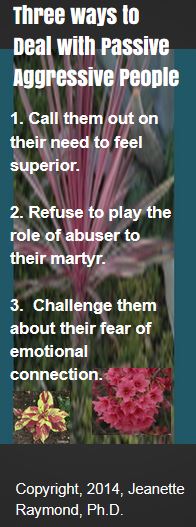
Three Ways To Stand Up To Passive Aggressive People

August 11th, 2014 Comments Off on Three Ways To Stand Up To Passive Aggressive People


Anger and Stress Management Tips for Satisfying Relationships by Dr. Jeanette Raymond, Ph.D.

west los angeles anger management therapy

Don't you just grit your teeth and want to tear your hair out with fury when your loved ones pretend they are not angry or upset, yet make snide remarks?

Don't you feel that they are trying to be better than you, by trying to be in full control of their anger, only to let it out in far more cruel ways?

Aren't you longing to get them to show their rage and be equally human with you?

If so then you want to have a more authentic and intimate relationship, which involves being open and upfront with your emotions, including anger.

Loved ones who use passive aggressiveness to handle their feelings are afraid of emotionally intimacy.

  •   They would rather withdraw and poke you from afar so that they can shield themselves from the impact they have on you, and vice versa.
  •   They prefer to take what they believe is the moral high ground, so that they can feel superior. Putting themselves on top is a way of avoiding emotional closeness.
  •   They get a kick out of playing the martyr role and force you to become the abuser who is harming them.


Why live in a place of frustration? All it does is bring you stress and cause you to hate your loved ones. You have more fights and battles about who is the better person or who is the most honest.

You can't make a martyr change with your anger or revengefull thoughts. Nor can you compete with them for martyrdom!

What you can do is to make them look in the mirror and show them how they care more about:

  • being superior than having a strong connection with you
  • being safe behind the walls of martyrdom than taking the risk of learning how to be emotionally intimate and strong simultaneously
  • seeing you as the monster so they can feel good about themselves.

Copyright, Jeanette Raymond, Ph.D.

AUTHOR OF: Now You Want Me, Now You Don't! Fear of Intimacy: Ten ways to recognize it and ten ways to manage it in your relationship.

You might also like:

Avoid the pain of losing loved ones becasue of anger issues

How to be equal partners in your marriage

Dealing with anger when you feel emotionally blackmailed


Disclaimer: this article is for informational and educative purposes only. Dr. Raymond is not responsible for any reactions you may have when reading the content or using the suggestions therein. Interacting with this material does not constitute a therapeutic relationship with Dr. Jeanette Raymond


Four Ways To Turn Anger Into Love

June 30th, 2014 Comments Off on Four Ways To Turn Anger Into Love


Anger and Stress Management Tips for Satisfying Relationships by Dr. Jeanette Raymond, Ph.D.


turning anger into love 2


FOUR FALSE PREMISES ABOUT RELATIONSHIPS THAT MAKE YOU ANGRY AND STRESSED.

1. You expect loved ones to read your mind.

When you are full of anger and rage that your loved ones don't treat you with respect or consideration, chances are you expect them to read your mind. You are sure that they know what's going on for you and deliberately ignore it, making you suffer.

That's what's make you angry and unloving.

2.  You believe that your loved ones know what you want and when you want it.

So you don't figure stuff out for yourself. You don't take the trouble to work out exactly what you want and why, leaving you in an unsettled place, angry that your loved one is not doing the job you assigned them.

So you blame them and push them away by spewing out all their faults.

3. You shouldn't have to feel the discomfort of sensing your needs.

When your loved ones don't instantly tune into your needs you get angry, because now you have to actually feel those needs and put them into words. But that is shameful, so you switch your focus to preparing a litany of their faults. Much more comfortable to see the evil in them than the shame of feeling needy in yourself.

So you start accusing them of all the wrongs they have ever done you and push them away even further from ever being able to see and meet your needs.

4. You believe that it's justified to punish your loved ones for not taking care of you even though you haven't told them what you want.

When you feel aggreived, you want to punish and feel strong by avenging yourself.

So you shut the door to all communication, give your loved ones the silent treatment and the cold shoulder. You are icy on the outside but smoulder on the inside.

5. You beleive that loved ones aren't human when they fail you.

When your loved ones fail to sense your needs and take care of your feelings before they become intolerable, you forget that what you really want it to feel close and connect – to be important and meaningful in their lives- intimate in an exclusive way.  Anger blinds you to your true purpose and all you want to do is to obliterate those who make you feel so insignificant.

So you use your anger to obliterate your humanity and that of your loved ones. You can't feel for them or yourself. Destruction is the only option.

relationship problems psychotherapy Los Angeles

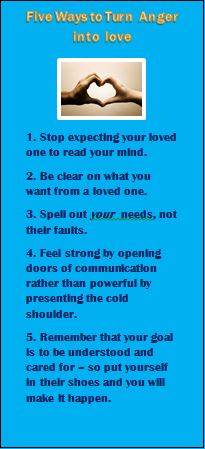
NOW YOU CAN USE THESE FIVE WAYS TO COUNTER THAT ANGER AND TRANSFORM IT INTO LOVING CONNECTIONS

1. STOP EXPECTING YOUR LOVED ONES TO READ YOUR MIND

2. BE CLEAR ON WHAT YOU WANT FROM A LOVED ONE

3. SPELL OUT YOUR NEEDS, NOT THEIR FAULTS

4. FEEL STRONG BY OPENING DOORS OF COMMUNICATION, RATHER THAN POWERFUL BY PRESENTING THE COLD SHOULDER

5. REMEMBER THAT YOUR GOAL IS TO BE UNDERSTOOD AND CARED FOR – SO PUT YOURSELF IN THEIR SHOES AND MAKE IT HAPPEN. START GETTING A GLIMPSE OF WHERE THEY ARE AT AND THEN THEY WILL DO THE SAME FOR YOU.


Copyright, Jeanette Raymond, Ph.D.

AUTHOR OF: Now You Want Me, Now You Don't! Fear of Intimacy: Ten ways to recognize it and ten ways to manage it in your relationship.

You might also like:

Avoid the pain of losing loved ones because of anger issues

Feeling insecure in your relationship makes you more prone to angry outbursts

Six ways to manage anger when you feel ignored


Disclaimer: this article is for informational and educative purposes only. Dr. Raymond is not responsible for any reactions you may have when reading the content or using the suggestions therein. Interacting with this material does not constitute a therapeutic relationship with Dr. Jeanette Raymond


Stress Prevents you From Using Your Skills in Controlling Negative Emotions

May 19th, 2014 Comments Off on Stress Prevents you From Using Your Skills in Controlling Negative Emotions

Anger and Stress Management Tips for Satisfying Relationships by Dr. Jeanette Raymond, Ph.D.

 west los angeles anger management

Have you ever been annoyed and frustrated that everything you learned and practiced about managing your emotions failed you at the crucial moment?

It’s so disappointing when you have been to an anger management class, or spent time and money on CD’s, DVD’s and or coaches to help you master those intense feelings, only to find that you can’t access that learning when you need it the most.

That’s what happened to thirty-six-year-old Hugh a film distributor over and over again when he was out in public with his thirty-four-year old second wife June, a publicist. He was very much in love with June who was beautiful, smart and caring – so different to his first wife who only seemed interested in material things and never made him feel good as a person. Yet, at one of the many parties they attending, when June didn’t go to his side the minute he called her, he felt the blood rush to his head and an irritated voice coming out of him – getting angrier and angrier with each demand he made.

west los angeles therapy for stress related anger


He ‘knew’ she was just mingling and playing the crowds, but something inside him overrode that information, and he became belligerent.

His stress levels were through the roof and he couldn’t just stand there and wait. He pulled her away from the people she was with, castigating her for not obeying him as she should. June was mortified and made him sleep on the sofa. She didn’t speak to him the next day, and Hugh was left ashamed and scared that he might lose this wonderful woman.

Aware of his quick temper when he didn’t get an immediate response from her, June encouraged her husband to attend anger management classes.

She also bought him the latest expert DVD’s on handling anger productively. Hugh wasn’t keen, but he knew he had to do something drastic to make sure his life and his relationship didn’t go south. He learned some useful strategies in his 12 week class, and thought he had it licked. He’d practiced the skills in class and rehearsed them when he was out on the road, but somehow the emotional aroused in him when he didn’t get June’s attention immediately, just overcame all his learning and hickjacked him. The anger burst out, even though a couple of minutes later, he apologized and said he ‘knew’ he should have given her a signal that he was feeling insecure.

Topping up the classes with the CD’s made Hugh feel like he got a second chance, and this time he was going to conquer his angry outbursts. But despite his perfectly learned signals, breathing exercises and words to say how he felt instead of exploding, the anger erupted, as if against his will.

west los angeles therapy for self-hate


Unbelievably anxious and frustrated that his genuine efforts at anger management were fruitless, he started to beat himself up

 He got very concerned that June’s patience would run out, leaving him alone and unhappy. Hugh tried to beat himself up into being a calmer guy around June, until he realized he needed professional help. He first tried a life coach and the personal touch made things a lot better. He got to call the coach when he thought he would explode and get taken to a safer emotional place. After nine months, he ended the contract, believing he was cured. One month later, he was devastated when that same old explosive anger reared its ugly head while he was shopping with June, and she didn’t respond to his pleas to hurry up. He flew off the handle and embarrassed them both.

 west los angeles therapy for stress related marriage problems

 Disgusted with himself and angry as hell that all his learning and coaching hadn’t done the trick, Hugh went to therapy – Cognitive Behavioral Therapy.

Now, finally he discovered the core beliefs that were being engaged when he blew up. He learned about the triggers that made him explode. And most of all he learned how punishing himself made things worse. He had a whole list of other ways to think that would prevent the anger from bursting out even though he knew it was inappropriate.

For the next six months Hugh was in seventh heaven. He was using his new found skills, and feeling successful. But one day he was upset when June said she was going on a two week business trip to promote a client’s book. Hugh got anxious. He knew there was no need to worry, but the stress got to him and all his skills flew out the window. He screamed at June for leaving him and accused her or not caring. He had gone ballistic.

west los angeles counseling for anger and stress

Accessing his skills was like getting blood out of stone!


So why did the CD’s, the coaching and the Cognitive Behavioral therapy not have a lasting effect?

Because as reported in  Proceedings of the National Academy of Science, August 26, 2013, even the mildest amount of stress impairs the prefrontal cortex that tempers emotion with reason and judgment. All the techniques that Hugh learned in anger management class, the CD course and his Cognitive therapy were not able to withstand the effect that small amounts of stress can have on previously learned skills. Emotions win out, as the stress alters and or blocks the communication from the prefrontal cortex to the amygdala (the emotional center of the brain). So Hugh didn’t stand a chance.

Things finally shifted for Hugh when he started attending therapy that focused on the emotional experiences that made him insecure and stressed. He found that he had to return to the source of the upset that stressed that as a child he could only express through anger. In his therapy Hugh made the connection between his mother always leaving him to talk to others, forgetting him in stores, at the county fair and so on, and his intense anger. The connection he made wasn’t just insightful. He felt it in his sessions when he was secure that the therapist wouldn’t do likewise. That’s when the stress diminished, and he was able to truly feel June’s commitment to him. Before he ‘knew it.’ Now he ‘felt it.’ It made all the difference. He and June are now much more stable. When those old buttons get pushed, he can use all the skills he learned but apply them at a feeling level – so that his rational and emotional brains synchronize and make him behave as he wants.

Copyright, Jeanette Raymond, Ph.D.

You might also like:

Do you numb yourself in an effort to control your angry outbursts, only to have them explode later on?

Unresolved anger and stress keeps you depressed longer

How to relieve stress in a marriage by sharing jobs

Disclaimer: this article is for informational and educative purposes only. Dr. Raymond is not responsible for any reactions you may have when reading the content or using the suggestions therein. Interacting with this material does not constitute a therapeutic relationship with Dr. Jeanette Raymond


Are You Losing Loved Ones Because of Anger?

May 5th, 2014 Comments Off on Are You Losing Loved Ones Because of Anger?

Anger and Stress Management Tips for Satisfying Relationships by Dr. Jeanette Raymond, Ph.D.

west los angeles anger management

Has your loved one told you that they want nothing more to do with you until you learn how to manage your anger?

Are you scared that you will lose your loved one for ever, be alone and miserable for the rest of your life?

Do you wish you could just cut out that angry part of you and then live happily ever after?

Then you must be feeling ashamed and even more angry that you can't get rid of that angry monster inside you. Angry at yourself you punish yourself in a masochistic way.

Watch this video and learn why you are so angry that other people make relationships with you conditional on you taming your anger!

Discover what it is that you want more than anything from your loved one that they aren't giving you – which infuriates you.

Then follow the strategy I give you to fill yourself up with good feelings so tha you can avoid the pain of feeling abandoned and unloved.

Try it before it gets to the stage where you are forced to come to therapy to deal with the anger that is costing you your dreams.


Copyright, Jeanette Raymond, Ph.D.


You might also like:

Depression buries the anger that keeps you from connecing with loved ones

How to get your loved one to prove their love without using anger

Managing anger that comes from feeling unwanted and insecure

Disclaimer: this video is for educational and informational purposes only. There is no liability on the part of Dr. Raymond for any reactions you may have when reading the material or following the suggestions therein. Interacting with this material does not constitute a therapeutic relationship with Dr. Raymond.




Feeling Insecure In Your Relationship Makes You More Prone To Angry Outbursts

April 25th, 2014 Comments Off on Feeling Insecure In Your Relationship Makes You More Prone To Angry Outbursts


Anger and Stress Management Tips for Satisfying Relationships by Dr. Jeanette Raymond, Ph.D.

West Los Angeles Anger Management for Insecure Relationships

Do you believe your loved ones when they tell you that they love and want to be with you?  OR are you suspicious of their intentions when they invite you to hang out with them?

Are you constantly testing them out? Then you may have a deep sense of insecurity just like forty-year-old Mackenzie, a stock broker, who blew up into a rage whenever he thought that his long-time girlfriend Pauline was lying about her wish to marry him.

Out at a restaurant with thirty-nine-year-old beautician Pauline and their friends, he was upset that she seemed engrossed in a conversation with Mark about a basketball game. Feeling excluded and uninteresting to her, he got scared that she would soon leave him. The vision of Pauline abandoning him brought up intense anger. He goaded her all way home about her disinterest in him during the meal. No matter what reassurances Pauline offered, he was determined to make her admit that she didn’t care for him because he was so insecure in their relationship.

anger managment psychotherapy, Los Angeles

By the time they got inside their apartment Mackenzie was trembling with anger and fear.

“Why don’t you admit it?” he yelled, “You think I bring your mood down!”

No longer able to hold her tongue against these false accusations, Pauline snapped.

“You know what! You’re right, when you poke and prod me into not liking you, then yes, I don’t like being out with you because you have habit of destroying the nice time we had,” she yelled as she walked out, refusing to be baited anymore.

Mackenzie’s rage at being rejected and victimized made him feel even more insecure – alone, uncertain as to what would happen between him and Pauline and scared as to whether he would ever be wanted or loved again. He started texting her furiously to try to reconnect but Pauline didn’t respond. Each of his frantic texts got more desperate and insulting hoping to spark a response but all he got was a blank screen.

west los angeles counseling for anger problems in romantic relationships

In several studies conducted with chronically insecure people, the Journal of Personality and Social Psychology Bulletin, (2009) found that the tendency to get angry and enraged got higher when the feelings of powerlessness and insecurity were at their strongest.

In addition, insecure people believe that their loved ones see them as insecure and likely to leave even when their loved ones do not judge them that way. The insecure individuals then became suspicious of their partner’s authenticity and damage the relationship.

Mackenzie fits the profile that the researchers described and lost out on a warm and nurturing relationship with Pauline. The anger that stemmed from his insecurity had previously ended a gentle and affectionate relationship with Mandy some three years ago. Two years before that his insecurity based anger had killed the friendship he had with a co-worker just as it was starting to move into a romantic phase.

Angry at himself for losing control and not being able to test Pauline out anymore, Mackenzie tried to meditate and calm himself down. He hoped it would prove to Pauline that he wasn’t a monster and that he could learn to be more secure. But she didn’t want to be put through his insecure tests again and left his life for good. His anger was still there as large as life despite his meditation exercises. So he gave it up.

    west los angeles psychotherapy for insecurity and anger

Disgusted with himself for being so insecure and destructive, Mackenzie had a series of hypnotherapy sessions, hoping that his insecurity and anger could be eliminated from his being, washing him clean. It worked for three months; until Mackenzie got attached to a girl he met at a friend’s party. Within a month he started to feel those familiar pangs of insecurity when she wanted time to herself or was busy with something else. At their next meeting he was irritable, angry with her for not wanting to be with him, and the taunting and testing of her commitment started.


Shocked that he was still feeling angry and insecure so soon after the hypnotherapy, he decided to try psychotherapy. He hated having to do it with every bone in his body. He just wanted to get this annoying part of him out of the way and then everything would be fine. But what he discovered was that wishing it away just made it worse and then he was filled with self-loathing.

He started and stopped therapy over and over again for the first year, until he surrendered to the fact that he couldn’t change without understanding the roots and reasons for his insecurity – and he certainly couldn’t control his anger until he understood where it was coming from.

Reluctantly Mackenzie talked about his fears growing up when he saw his parents split and come together and split again. He was never secure in his mother’s love because she beat him when she was upset with his dad. Punished as a young boy Mackenzie dismissed the scars it left trying to be strong. But now the scars were throbbing and his rage at both his parents for creating so much insecurity in his life couldn’t be contained. As his therapy progressed and he felt more compassion for himself, letting out his anger at his parents, he was freed to build a relationship with a woman. He no longer had to sabotage his romantic relationships with his insecurity and anger.


Copyright, Jeanette Raymond, Ph.D.


You might also like:

Managing anger that comes from feeling unwanted and insecure

Rules about how to be secure in your relationship can end it!

Is anger the only way you can whip people into loving you?

Getting proof that your partner is commited to you

Disclaimer: this article is for educational and informational purposes only. There is no liability on the part of Dr. Raymond for any reactions you may have when reading the material or following the suggestions therein. Interacting with this material does not constitute a therapeutic relationship with Dr. Raymond.


OCD Therapy May Involve Getting in Touch with Suppressed Anger

June 18th, 2013 Comments Off on OCD Therapy May Involve Getting in Touch with Suppressed Anger

Anger and Stress Management Tips for Satisfying Relationships by Dr. Jeanette Raymond, Ph.D.

west los angeles therapy for ocd and anger

For the seventh time in less than a minute twenty-five year old Denise, a proof reader, found herself checking that she had marked the page she ended on before she closed the book. Each time she put the book down and tried to get out of her chair a huge wave of anxiety and panic swept over her. She couldn’t be sure she had marked the last page she had read and that meant that she would have to start the book all over again. As the panic washed over her she ‘knew’ that she had marked the page but she wasn’t positive until she had checked again. A blanket of relief came over her when she found the page marked, but it was instantly replaced by another dose of doubt that started the checking cycle all over again. It was as if she couldn’t hold on to that proof for more than a Nano second. Irritation and annoyance gave her a break from the anxiety and panic, but she was exhausted with these obsessive doubts, and her compulsive checking.

Feeling fatigued and depleted of energy Denise had no desire to go to her twenty-five year old sister Eileen’s birthday party. She just wanted to stay home and veg out. Just two hours ago she had been looking forward to the party. She had thought about what to wear and imagined playing with her two-year old niece Shelly and her one year old nephew Felix. But now it just seemed too much of a burden. 

west los angeles anger managemen

photograph copyright, Jeanette Raymond, Ph.D.

One set of OCD syptoms lessened only to start up another set of OCD symptoms

The more she thought of the effort she would have to make to get ready and drive over to her sister’s place the more she started to worry about the notes she made as she did her proof reading. Were they complete? Were they legible? Would she be able to remember the nuanced points she needed to highlight as she prepared her final draft? The thoughts became so loud in her head that she had to go back and check all her notes, and not just the ones she had made that day. Panic drove her to check and recheck the entire set of notes she had made since starting the book, all the way to the penultimate chapter that she was now on.

Denise was consumed by the job. There was a mild rush of anxiety as she checked each page of notes, scanning for legibility and errors. But overall there was a massive sense of relief, as if she’d just been dropped into a soft feather bed. She felt weightless and free despite the rumblings of anxiety about her notes. By the time she had finished it was late and the party would be coming to an end.

west lost angeles counseling for anger and ocd symptoms

photograph copyright, Jeanette Raymond, Ph.D.

Obsessive thoughts rescued Denise from having to face her envy of Eileen

The obsessive thoughts and compulsive acts had made Denise uncomfortable in the moment but they saved her from a fate much worse. For years she had been envious of her sister. Eileen had been the golden girl doing everything in life at the expected time and being praised for it by her parents. Denise was less outgoing and yearned for a slower pace of life. She found some peace and comfort when Eileen got married and moved out. She and her parents enjoyed their time, doing stuff together without any pressure on her to grow up and be like her sister. But then the first grandchild came along and her mother in particular was enchanted. She spent more and more time with Shelly and then when Felix came along both grandparents built their lives around Eileen and the grandkids. Denise’s comfortable existence was shattered.


Suppressed anger often leads to Obsessive Compulsive (OC) symptoms

She was angry and frightened at having to go it alone. Eileen had a smooth transition from home to marriage and family, but Denise was thrown in at the deep end and her rage was enormous. But the shame of her envy and anger was overwhelming. She couldn’t live with it choking her every waking moment. She couldn’t get rid of it either, so the only safe compromise was to distract herself from the envy and rage – by focusing on checking and rechecking her work. It did the trick since she never felt bad about her sister or the loss of her parents company. That took care of the stress that otherwise threatened to swallow her up.

Treatment for OCD and suppressed anger

photograph copyright, Jeanette Raymond, Ph.D.

Why on earth would OCD be useful?

Obsessive Compulsive behaviors often come to rescue you from anger and rage that feels shameful and destructive. An article in the Journal Cognitive Therapy and Research 2004 reported that people high in OC symptoms tended to experience more anger than those without OC behaviors. They also had greater difficulty controlling the anger and suppressed it as a way of managing the negative experience of their rage.

Another piece of research published in the Industrial Psychology Journal in 2001 showed that people with OC symptoms experience attacks of anger that become intolerable and result in depression to quiet it down.


OCD Therapy – Denise went to therapy from time to get relief from the exhaustion and annoyance of her OC symptoms. Each time she tried out the strategies of self-talk and refocusing it worked for a short time and then just like her OC it came back as strong as ever. But what did eventually make the OC go away was when Denise was able to feel safe enough to deal with her anger, envy and shame in therapy. Taking the risk of feeling those awful feelings freed her from the need to screen them, hide from them and ruin her life in the process. So when you want to know how to cure OCD think of the long term, go in for the long haul and deal with all the unbearable emotions that OCD may cover up and you will be free.

Copyright, Jeanette Raymond, Ph.D.

You might also like:

Understanding your panic attacks, part 1 – facing your dilemas

Understanding your panic attacks, part 2 – getting past shame

Understanding your panic attack, part 3 – fear of going it alone

Disclaimer: this article is for informational and educative purposes only. Dr. Raymond is not responsible for any reactions you may have when reading the content or using the suggestions therein. Interacting with this material does not constitute a therapeutic relationship with Dr. Jeanette Raymond, Ph.D.